In the variable-editor, selecting Certificate as the variable type allows you to create a variable with a certificate managed by Octopus as the value.
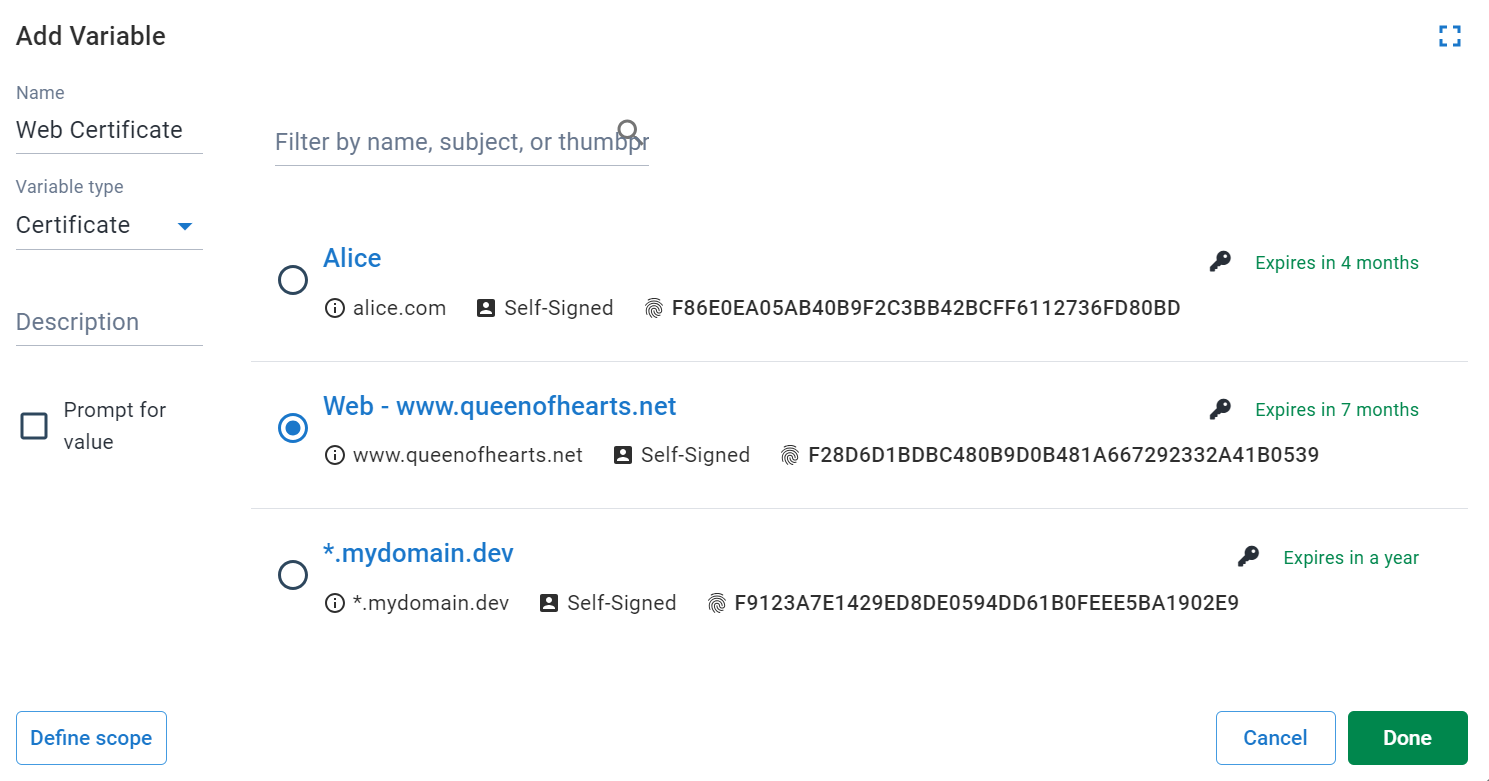
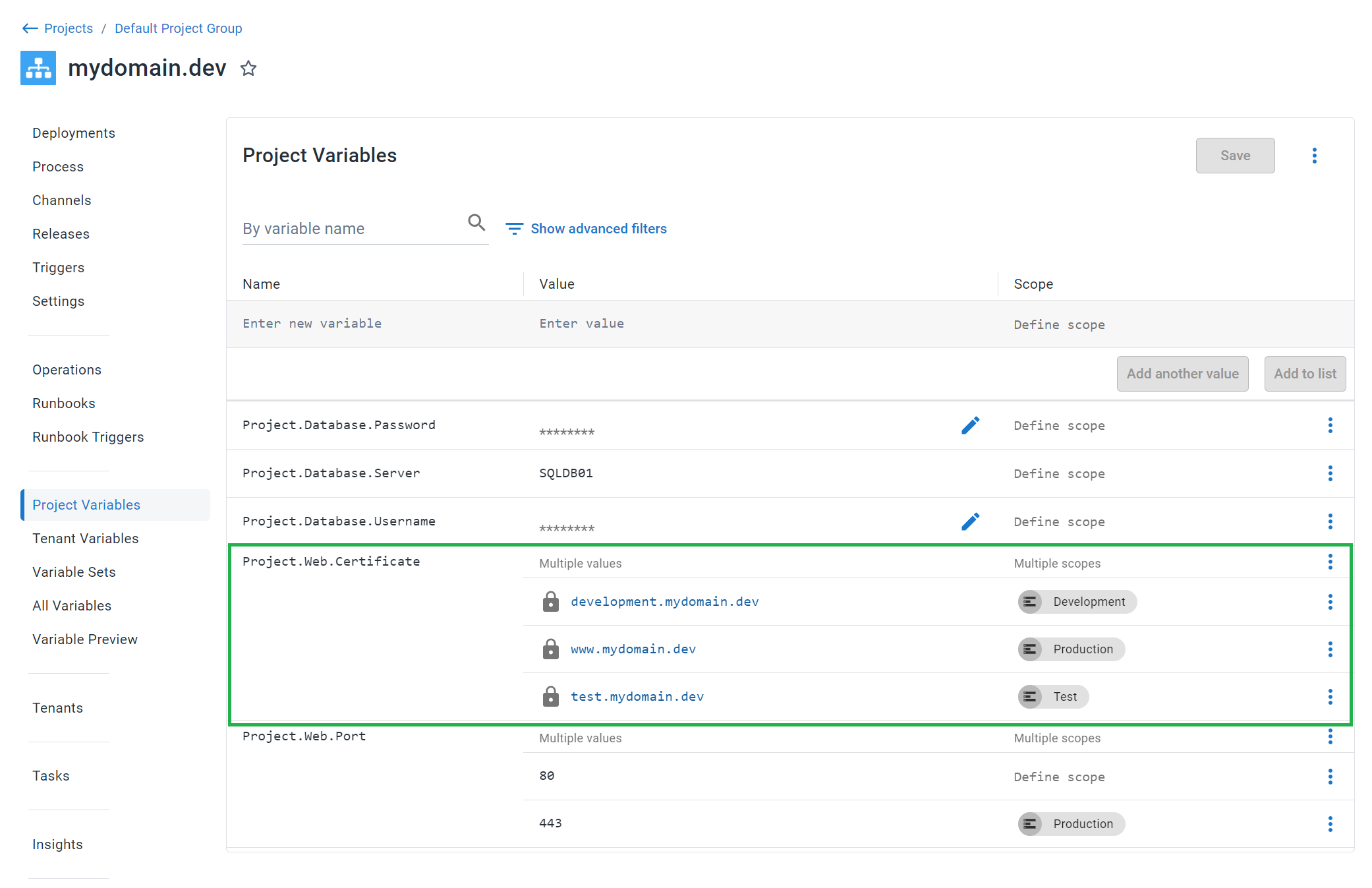
Certificate variables can be scoped, similar to regular text variables.
Expanded properties
At deploy-time, certificate variables are expanded. For example, a variable MyCertificate becomes:
| Variable | Description | Example value |
|---|---|---|
MyCertificate | The certificate ID | Certificates-1 |
MyCertificate | The variable type | Certificate |
MyCertificate | The user-provided name | My Development Certificate |
MyCertificate | Thumbprint | A163E39F59560E6FE33A0299D19124B242D9B37E |
MyCertificate | The base64 encoded original file, exactly as it was uploaded. | |
MyCertificate | The password specified when the file was uploaded. | |
MyCertificate | The base64 encoded certificate in PKCS#12 format, including the private-key if present. If the originally uploaded certificate was password-protected (i.e. MyCertificate is not empty), then this value will also be a password-protected PFX (PKCS#12) format. | |
MyCertificate | The base64 encoded DER ASN.1 certificate. | |
MyCertificate | The base64 encoded DER ASN.1 private key. This will be stored and transmitted as a sensitive variable. | |
MyCertificate | The PEM representation of the certificate (i.e. the PublicKey with header/footer). | |
MyCertificate | The PEM representation of the private key (i.e. the PrivateKey with header/footer). | |
MyCertificate | The PEM representation of any chain certificates (intermediate or certificate-authority). This variable does not include the primary certificate. | |
MyCertificate | The X.500 distinguished name of the subject | |
MyCertificate | The un-attributed subject common name | |
MyCertificate | The X.500 distinguished name of the issuer | |
MyCertificate | NotBefore date | 2016-06-15T13:45<30>.0000000-07<00> |
MyCertificate | NotAfter date | 2019-06-15T13:45<30>.0000000-07<00> |
Example usage
Given the certificate variable MyCertificate, you can access the certificate thumbprint in a script like this:
PowerShell
Write-Host $OctopusParameters["MyCertificate.Thumbprint"]Bash
thumbprint=$(get_octopusvariable "MyCertificate.Thumbprint")
echo "$thumbprint"It’s possible to write the PEM representation of the certificate to a file for use directly with a web server e.g. Apache, or a reverse proxy like NGINX. In bash, the script looks like this:
CERT=$(get_octopusvariable "MyCertificate.CertificatePem")
echo "$CERT" > my_cert.crtIf your certificate also contains any chain certificates (e.g. intermediate or certificate authority), they can be written to a file that contains the primary certificate too. The following example shows how to do so in bash:
CERT=$(get_octopusvariable "MyCertificate.CertificatePem")
CHAIN=$(get_octopusvariable "MyCertificate.ChainPem")
COMBINED_CHAIN="$CERT\n$CHAIN"
echo -e "$COMBINED_CHAIN" > my_combined.crtIf your certificate also has a private key that you need to export, you can use the PrivateKeyPem property using bash:
KEY=$(get_octopusvariable "MyCertificate.PrivateKeyPem")
echo "$KEY" > ssl.keyLearn more
Help us continuously improve
Please let us know if you have any feedback about this page.